With the inception of Rajasthan University of Veterinary and Animal Sciences at Bikaner in 2010, the Directorate of Extension Education emerged as the pivotal unit. Its primary function is to serve as the central hub for planning, organizing, and monitoring all extension activities carried out by the University working closely with the various departments of constituent colleges of the university. The Directorate of Extension Education collaborates with Department of Agriculture, Department of Animal Husbandry, Agricultural Technology Management Agency, ICAR and other extension education agencies. Additionally, the Directorate directly administers Krishi Vigyan Kendra (KVK) located in Nohar (Hanumangarh) and Pashu Vigyan Kendras located in different districts of Rajasthan. These PVKs and KVK offer training and technology transfer to farmers, rural youth, and field functionaries. The Directorate actively engages in transferring the latest technologies derived from the university’s research laboratories to the fields of farmers. Furthermore, it consistently gathers feedback from farmers and other stakeholders to shape its future strategies and effectively implement demand-driven research for the benefit of all involved stakeholders.
The main aim of Directorate of Extension Education is to transfer the well proven/tested technologies to the farmers, livestock owners, rural youth, extension functionaries of State Government and other personnel engaged in developmental and professional activities in the field of agriculture and allied areas through its well planned, skill-oriented and need based programmes. The Directorate of Extension Education acts as bridge between the research scientists and the farmers and other stakeholders who are involved in extension activities. Therefore, the role of Directorate is two folds, i.e. transfer of technologies from scientists to the ultimate users through field functionaries and to find out the problems of the field to be passed on to various research divisions of University for solutions. It also involves organization of animal treatment & infertility treatment camps, farmers training, exhibition, farmers-scientist interaction, front-line demonstration etc.
Broad Objectives
• To formulate and impart in-service training to different categories of officers and functionaries from line departments of Government of Rajasthan and Non-Government Organizations.
• To conduct short and long duration vocational trainings for farmers, farm women, youth and school dropouts of the State.
• To assess and refine the latest Animal Husbandry technologies through front-line demonstrations for their wider adoption.
• To provide farm information services through various extension activities including literature for quick dissemination of technology.
Overview of Activities
• Off campus and on campus trainings for the livestock farmers.
• Extension activities like Vichar Gosthies, farmer’s scientist interactions, awareness camps, animal treatment camps, field visits and feedback reviews were conducted regularly.
• Arranging Exhibitions in State and National level fairs organized for the farmer’s community.
• Radio Programme “Dhine Re Batyaa” for livestock farmers broadcasting form 17 All India Radio Stations of Rajasthan on third Thursday at 5:30 to 6:00 PM every month.
• Regular monthly publication of “Pashu Palan Naye Aaayam” and other technical folders.
• Toll free helpline i.e. 1800 180 6224 for the benefit of livestock farmers, veterinary doctors and students.
• Activities under SC-SP plan of ICAR and NABARD project running at different PVKs.
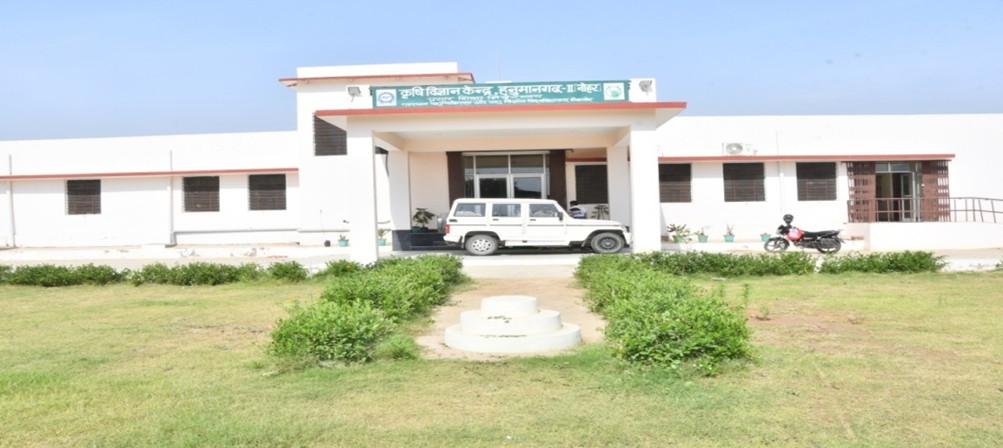
The first “Krishi Vigyan Kendra” was sanctioned to the university by ICAR, New Delhi in the year 2012 at Nohar (Hanumangarh) on 100% financing basis. The KVK started its functioning on 9th April 2012. The KVK is actively engaged in on-farm trials, front-line demonstrations, on campus and off campus farmers and farm women training and other extension activities such as field day, Kisan Mela, Kisan Gosthi, exhibition, method and result demonstrations, scientific visit to farmers field, exposure visit of farmers, animal health camps and farm science club and self-help groups conveners meet etc. The KVK is very helpful for the transfer of new techniques and technology to the farmers and livestock owners. The University is marching ahead to develop the KVK to be a model KVK where provisions will be made to provide all the facilities to the farmers.
Objectives
• Assessment and demonstration of agricultural technologies on the farmers’ field for their application and feedback.
• Capacity development through skilling and training of farmers, farm women, youth and extension functionaries.
• Act as an information and knowledge centre for providing diagnostic and farm advisories to farmers and other stakeholders.
• Production of quality seeds, planting materials and other technological inputs for availability to the farmers.
• Develop convergence and partnership with agriculture related ongoing schemes and programs of different departments and organizations on national priorities.
• Awareness creation and community mobilization on various issues related to agriculture & allied sectors through innovative extension activities including use of ICT and other media.
